Ask a Bhutanese where the country's spiritual roots lie and the answer is often the same: Bumthang. In this cluster of broad, high valleys in central Bhutan, Guru Rinpoche meditated in a cave, a Tibetan king founded one of the country's oldest temples, and a fifteenth-century treasure revealer leapt into a lake with a burning butter lamp. Bumthang is also simply lovely, with pine forests, wide fields of buckwheat and farmhouses with smoke curling from their roofs. Here is our guide to its four valleys and its most sacred sites.
Getting to know Bumthang
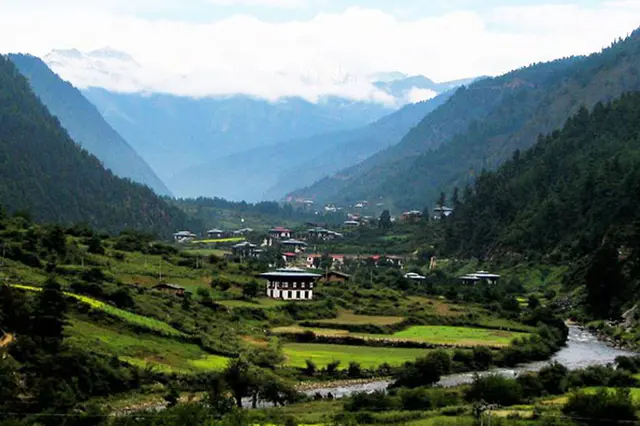
Bumthang is a district made up of four main valleys: Chhume, Chhoekhor, Tang and Ura. They lie at roughly 2,600 to 4,000 m, which makes Bumthang noticeably cooler than western Bhutan. Summers are fresh and green; winters are cold, with frost on the fields and occasional snow.
The main town is Jakar, in the Chhoekhor valley. It is small and friendly, with a single main street of shops, a few cafés and the Chamkhar Chhu river running past. Most visitors base themselves here and explore the valleys on day trips.
The four valleys
Chhoekhor
Chhoekhor is the largest valley and the one most travellers know best. It holds Jakar town, Jakar Dzong, Jambay Lhakhang, Kurje Lhakhang and Tamshing Lhakhang, all within a short drive or walk of one another. It is often simply called the Bumthang valley.
Chhume
Chhume is the first valley you reach when arriving from the west over the Yotong La pass. It is known for yathra, the colourful woollen textiles woven on backstrap and frame looms. In villages such as Zungney you can watch weavers at work and buy directly from them.
Tang
Tang is the most remote of the four, reached by a road that leaves the main highway east of Jakar. It is home to Membartshang Tsho, the Burning Lake, and to Ogyen Choling, a historic manor house that now serves as a museum of rural and aristocratic life.
Ura
Ura is the highest of the valleys, with a compact village of stone houses and cobbled lanes. It feels quite different from the rest of Bumthang, and its spring festival, the Ura Yakchoe, is one of the most atmospheric in the region.
Jambay Lhakhang: a seventh-century temple
Jambay Lhakhang is among the oldest temples in Bhutan. It is traditionally said to have been built in 659 CE by the Tibetan king Songtsen Gampo, as one of 108 temples raised across the Himalaya in a single day to pin down a giant demoness who was obstructing the spread of Buddhism. Jambay Lhakhang is said to hold down her left knee; Kyichu Lhakhang in Paro holds her left foot.
The temple is dedicated to Jampa, the Buddha of the future. It has been restored and added to over the centuries, but its age is palpable in the worn stone and the quiet, dim interior.
Each autumn, usually in October or November, Jambay Lhakhang hosts one of Bhutan's most remarkable festivals. The Jambay Lhakhang Drup includes the Mewang, a fire blessing in which people run beneath an arch of burning straw to cleanse themselves of misfortune, and a sacred midnight dance. Our Bumthang Fire Dance Festival Journey is built around it.
Kurje Lhakhang: where Guru Rinpoche left his mark
A short drive north of Jambay Lhakhang, Kurje Lhakhang is one of the most sacred sites in Bhutan. The name means "body imprint" temple. In the eighth century, according to tradition, Guru Rinpoche came to Bumthang at the invitation of a local king who had fallen gravely ill after offending a powerful local spirit. The Guru meditated in a cave here, subdued the spirit and restored the king's health, leaving the imprint of his body in the rock.
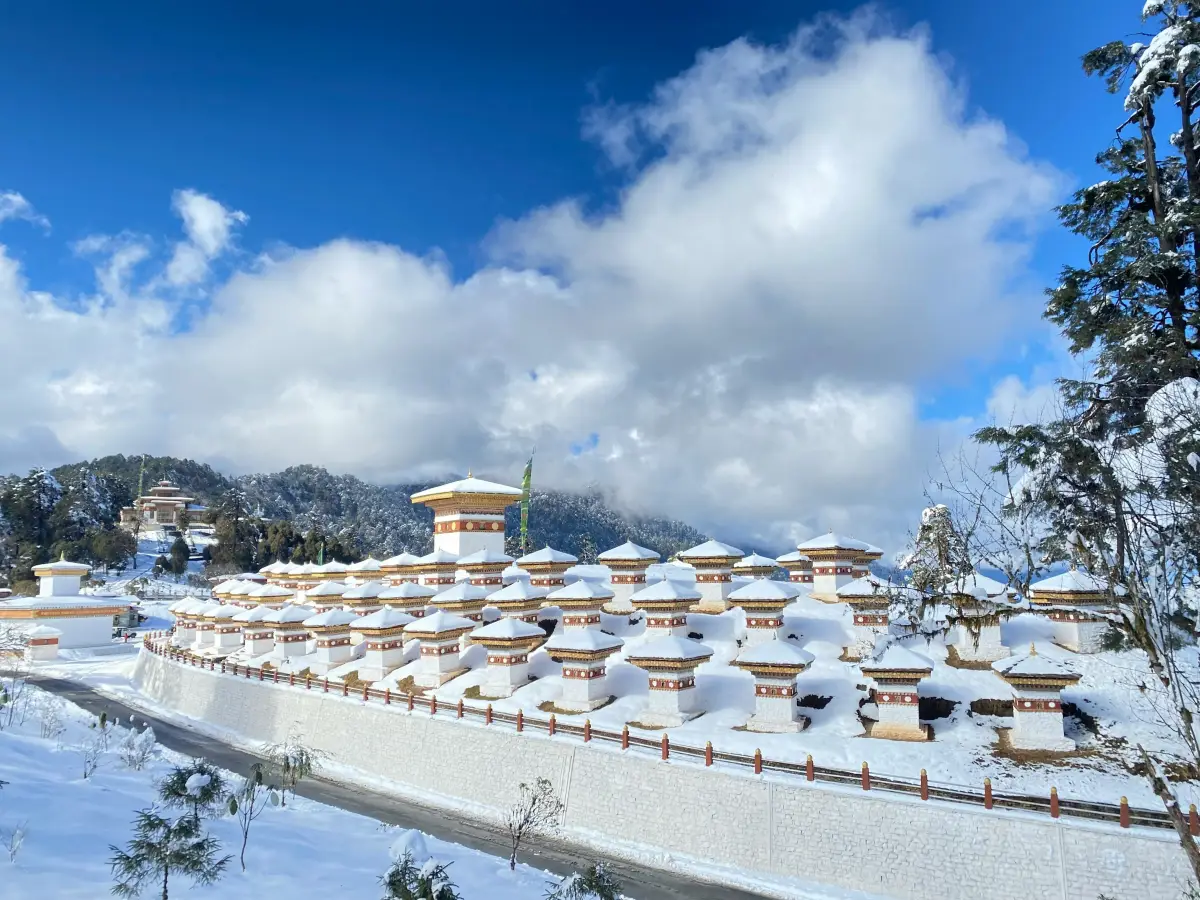
The complex has three temples. The oldest, built around the cave and the body imprint, dates from the seventeenth century; the other two were added in the twentieth century by members of the royal family. A wall of 108 chortens surrounds the complex. The annual Kurje Tshechu is usually held in early summer.
Our tip: walk the short trail across the river from Kurje to Tamshing Lhakhang. It takes you over a suspension bridge and through fields, and is a peaceful way to link two of the valley's great temples.
Jakar Dzong: the Castle of the White Bird
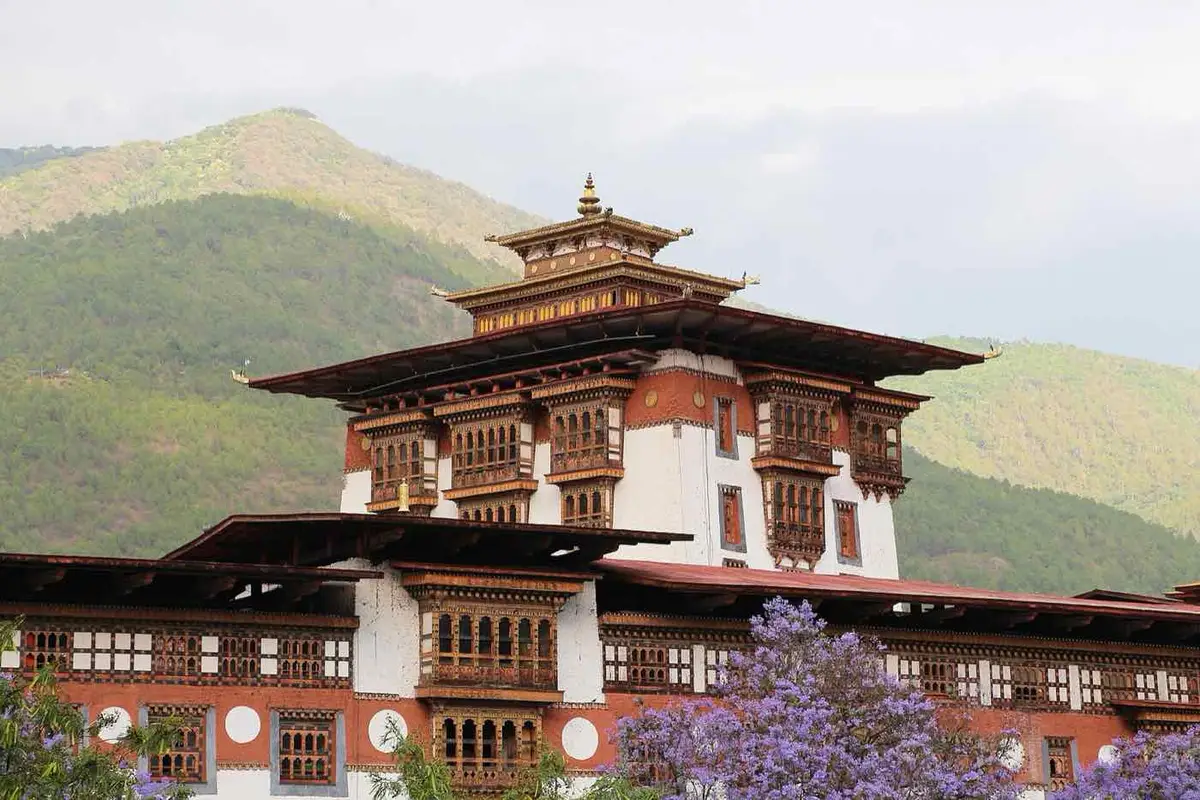
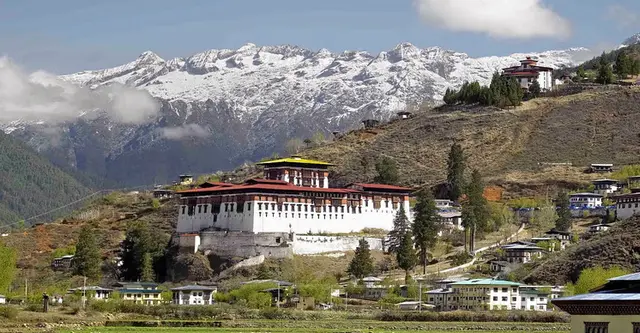
Jakar Dzong sits on a ridge above the town. Its name is usually translated as the Castle of the White Bird: legend tells that a white bird rose into the air and settled on this spur, which was taken as a sign that the dzong should be built here. A monastery was founded on the site in the sixteenth century, and the dzong was rebuilt in its present form in the seventeenth.
Today it houses the district administration and the monk body. Its walls are among the longest of any dzong in Bhutan, and the view down over Jakar and the Chhoekhor valley is one of the best in Bumthang.
Pema Lingpa and the Burning Lake
No figure is more closely linked to Bumthang than Pema Lingpa, born in the Tang valley in 1450. He is revered as the greatest of Bhutan's tertons, or treasure revealers: teachers believed to discover sacred texts and objects hidden by Guru Rinpoche for future generations.
His most famous revelation took place at Membartshang Tsho, a deep pool in a gorge of the Tang Chhu. Doubted by the local governor and an assembled crowd, Pema Lingpa is said to have leapt into the water holding a burning butter lamp, declaring that if he were a true treasure revealer he would return with the lamp still lit. He emerged holding a treasure, with the lamp still burning. The lake has been known as the Burning Lake ever since.
Today Membartshang Tsho is a quiet place of prayer flags, small clay offerings and butter lamps set on the rocks. Pema Lingpa also founded Tamshing Lhakhang in Chhoekhor, where visitors can see some of the oldest paintings in Bhutan.
Swiss cheese, beer and buckwheat
Bumthang has a food culture all its own. Rice grows poorly at this altitude, so buckwheat has long been the staple. Look out for:
- Puta: buckwheat noodles, often served with butter and chilli.
- Khuli: buckwheat pancakes, a Bumthang speciality.
- Local honey, apples and dairy, all produced in the valley.
Bumthang also has an unexpected Swiss connection. In the twentieth century, a Swiss volunteer, Fritz Maurer, settled here and helped start local cheese making and a small brewery. Bumthang's Swiss-style cheese and its Red Panda wheat beer are now firmly part of a visit, and tasting both is a pleasant way to end a day of temples.
Festivals in Bumthang
Bumthang has a rich festival calendar, and many of its celebrations are smaller and more intimate than the big Tshechus of Paro and Thimphu.
- Jambay Lhakhang Drup: autumn, with its fire blessing.
- Jakar Tshechu: autumn, at Jakar Dzong.
- Prakhar Duchhoed: autumn, in the Chhume valley.
- Kurje Tshechu: early summer.
- Ura Yakchoe: spring, in Ura village.
Dates follow the Bhutanese lunar calendar and change from year to year, so check before you book your flights.
Planning tips
- Getting there: the drive from Thimphu takes the better part of two days, with an overnight stop in Punakha, Phobjikha or Trongsa. Domestic flights to Bathpalathang airport near Jakar save time but depend on the weather.
- How long to stay: allow at least two or three nights to see the main sites of Chhoekhor and visit Tang or Ura.
- Pack warmly: Bumthang is cool even in summer and cold in winter.
- Go deeper: see our guide to Bumthang, or follow the trail of Bhutan's great teachers on our Footsteps of Guru Rinpoche journey.
Bumthang rewards those who slow down: a butter lamp flickering at the Burning Lake, a bowl of buckwheat noodles, a temple bell ringing across the fields. It is a place to linger, and one many of our guests remember most fondly.