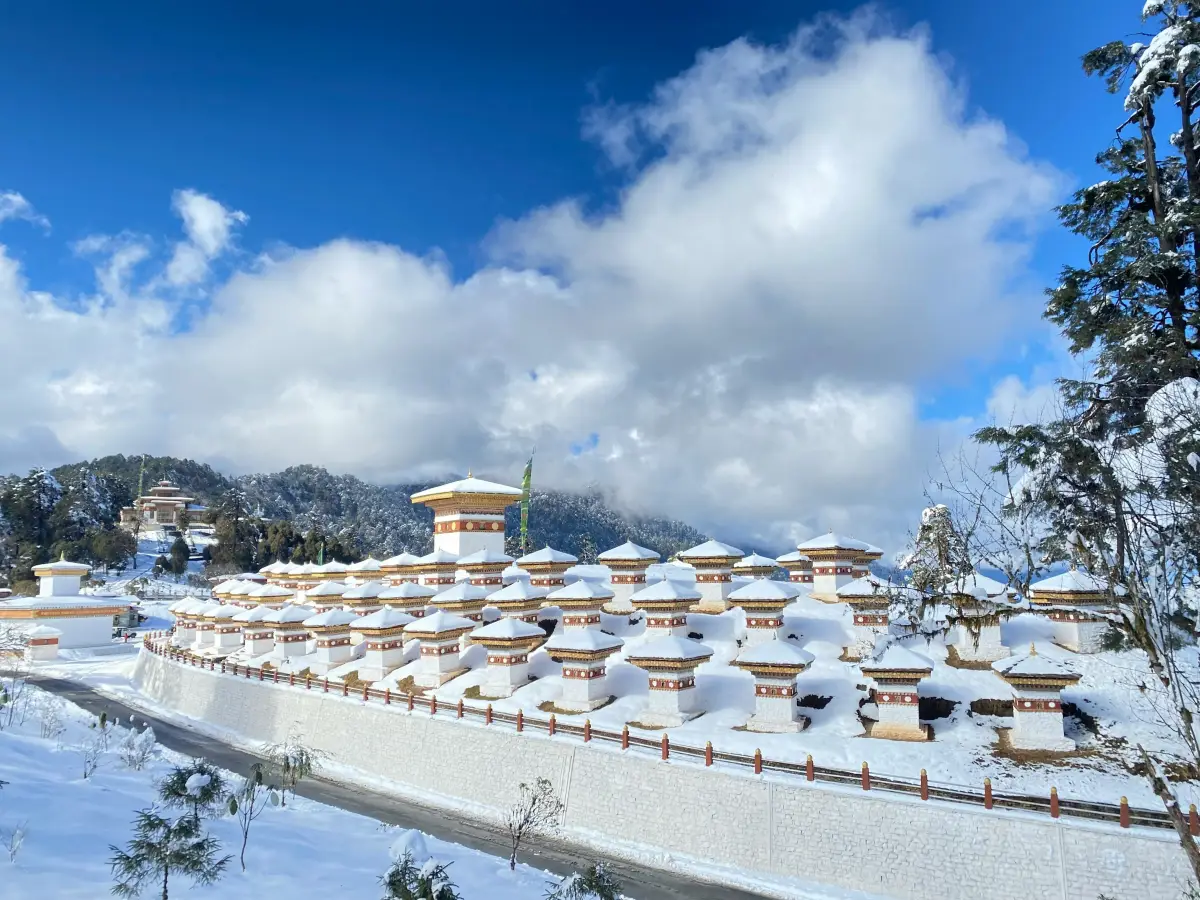
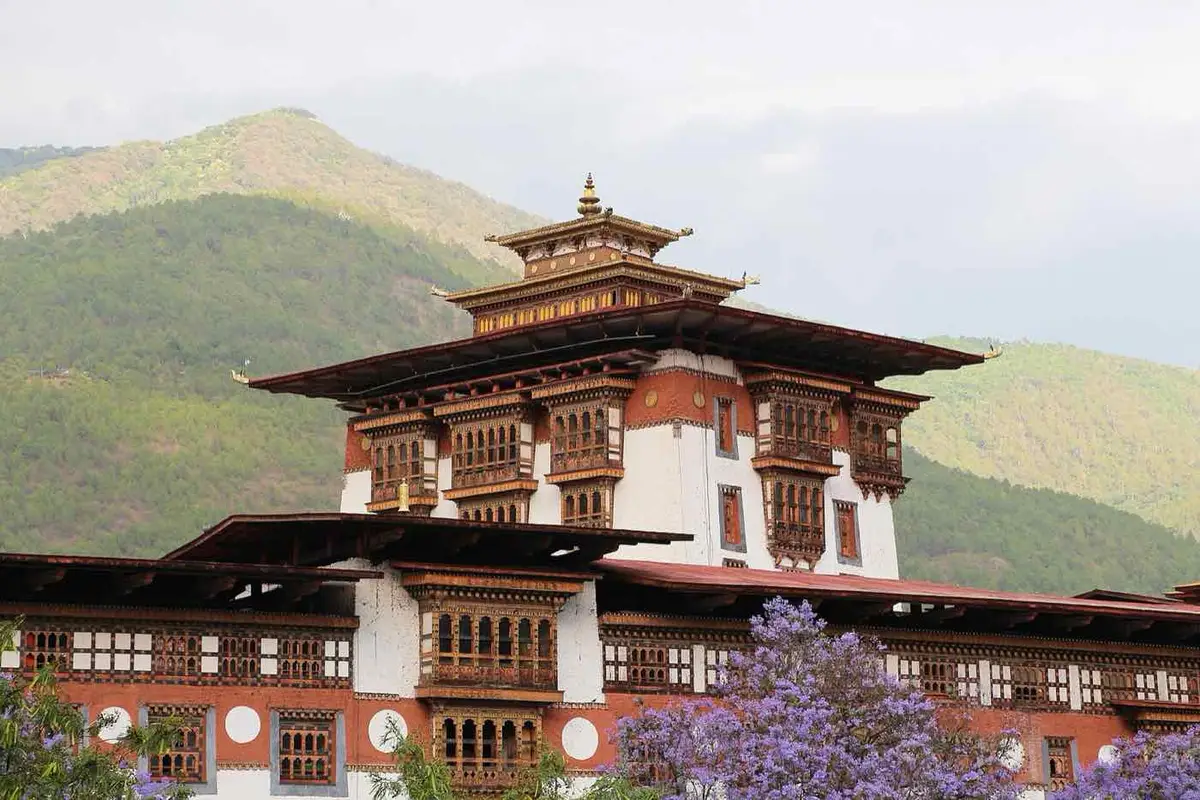
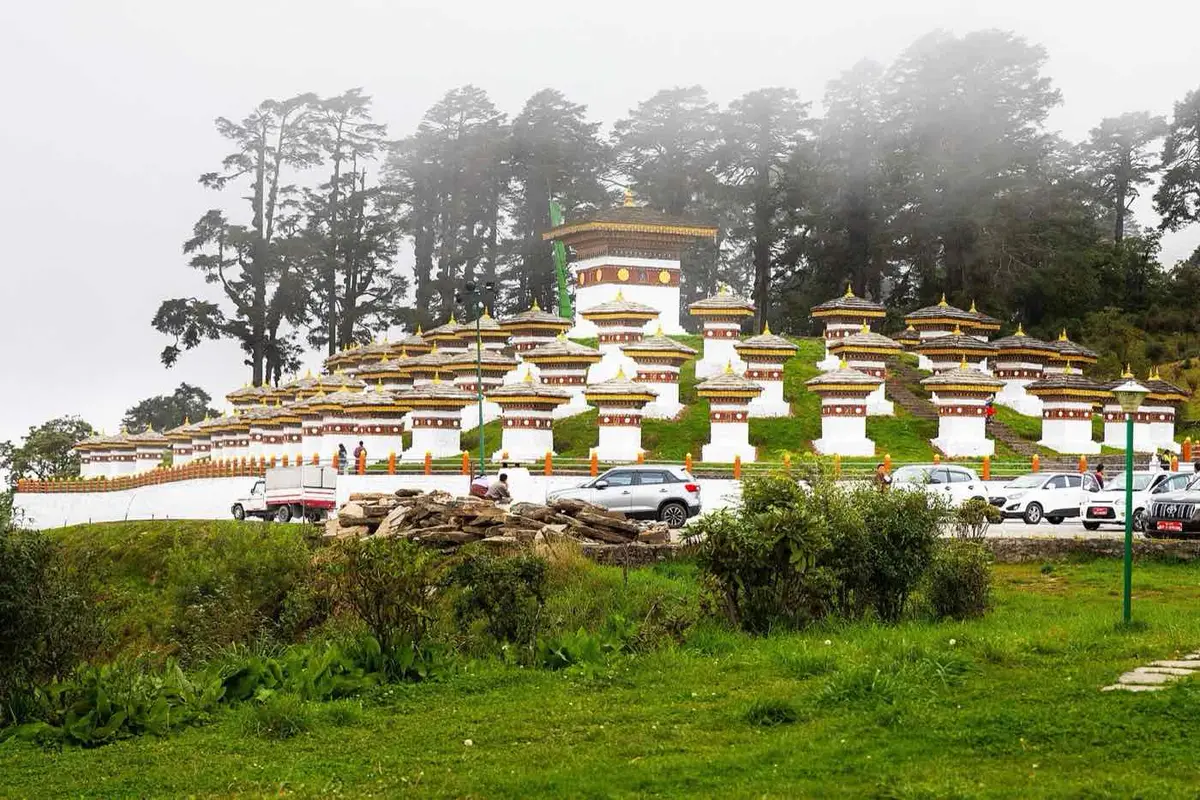
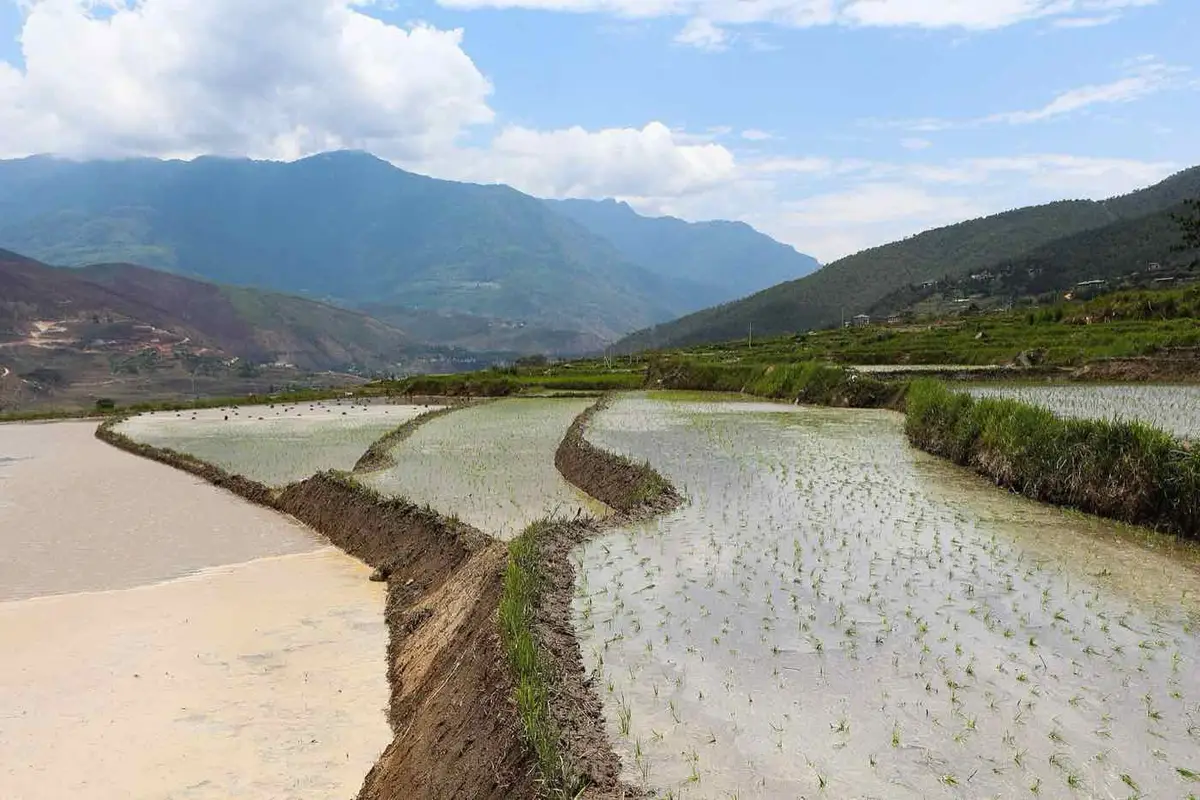
Drive down from the Dochula pass and the air grows warmer, the hillsides turn to rice terraces, and then, at a bend in the road, it appears: a great white fortress with golden roofs, floating where two rivers meet. Punakha Dzong is, for many visitors, the most beautiful building in Bhutan. It is also one of the most important, a place where the country was governed, its first king was crowned and its present king was married. This is the story of the Palace of Great Happiness, and how to see it well.
A fortress where two rivers meet
The dzong's full name is Pungthang Dewachen Phodrang, usually translated as the Palace of Great Happiness, or Great Bliss. It stands on a spit of land at the confluence of the Pho Chhu and the Mo Chhu, the "father" and "mother" rivers. The Pho Chhu flows down from the glaciers of Lunana in the far north; the Mo Chhu comes from the mountains towards Laya and Gasa.
The setting is not only beautiful but strategic. The rivers protected the dzong on three sides, and the Punakha valley, at a much lower altitude than Thimphu or Paro, offered a mild climate in winter. That is why Punakha served as Bhutan's capital and seat of government until the capital moved to Thimphu in 1955.
The Zhabdrung and the building of the dzong
Punakha Dzong was built in 1637–38 by Zhabdrung Ngawang Namgyal, the Tibetan lama who arrived in Bhutan in 1616 and went on to unify the country. It is the second oldest dzong in Bhutan, after Simtokha near Thimphu, and the second largest.
Tradition holds that Guru Rinpoche had foretold the coming of a man named Namgyal to a hill shaped like a sleeping elephant. The dzong is said to stand at the tip of the elephant's trunk. Bhutanese accounts also tell of a master builder who saw the design in a dream, and the dzong was raised, like all traditional dzongs, without written architectural plans.
What the dzong held
Inside its walls, the dzong combined religious and civil authority, as dzongs still do today. It housed monks and government officials side by side, a model of the dual system of governance that the Zhabdrung established. Today Punakha remains the winter home of the Je Khenpo, Bhutan's chief abbot, and the Central Monk Body, who move down from Thimphu each year for the colder months.
Kings, coronations and a royal wedding
Punakha Dzong has witnessed many of the defining moments of modern Bhutan.
- 1907: Ugyen Wangchuck was crowned here as the first hereditary King of Bhutan.
- 2011: the fifth king, Jigme Khesar Namgyel Wangchuck, married Queen Jetsun Pema at Punakha Dzong in October, in a ceremony watched across the country.
For Bhutanese, the dzong is not a museum but a living place of state and faith, and that sense of continuity is part of what makes visiting so moving.
The Machey Lhakhang
The most sacred room in the dzong is the Machey Lhakhang, which holds the preserved remains of the Zhabdrung himself. He died in 1651, but his death was kept secret for decades while the young state found its feet, with officials explaining that he was in long meditation retreat.
The Machey Lhakhang is closed to visitors. Tradition allows only a very few, including the King and the Je Khenpo, to enter. Knowing it is there, though, gives the whole building a quiet gravity. The dzong also keeps the Rangjung Kharsapani, a revered relic that the Zhabdrung brought with him from Tibet, and its defence against Tibetan forces is remembered each year in the Punakha Drubchen festival.
Fire, flood and restoration
Few buildings have survived as much as Punakha Dzong. Fires damaged it repeatedly, in 1780, 1802, 1831 and 1849 among other years, and again in 1986. A major earthquake in 1897 caused severe damage. The rivers that protect it have also threatened it: floods have struck several times, most seriously in 1994, when a glacial lake in Lunana burst and sent a surge of water down the Pho Chhu.
After each disaster the dzong was rebuilt, and a long restoration in the late twentieth and early twenty-first centuries returned it to its present splendour. Craftsmen used traditional techniques throughout, and the woodwork, paintings and gilded statues you see today are the work of Bhutanese artisans.
Tip from our guides: visit in spring if you can. Usually around April and May, the jacaranda trees around the dzong bloom a soft lilac, and the colour against the whitewashed walls is unforgettable.
Visiting Punakha Dzong
You enter across a covered wooden cantilever bridge over the Mo Chhu, rebuilt in the traditional style in the early 2000s after the original was lost to a flood in the twentieth century. A steep wooden stairway leads up to the entrance, and from there the dzong opens into a series of courtyards, each grander than the last.
What to look out for
- The courtyards: the dzong has three, with the central tower rising between them.
- The murals: detailed paintings of the life of the Buddha, protective deities and the wheel of life.
- The great assembly hall: a vast, columned hall with towering gilded statues of the Buddha, Guru Rinpoche and the Zhabdrung.
- The view from the bridge: the classic photograph of the dzong, best in the soft light of late afternoon.
Dress and etiquette
Wear long sleeves and long trousers or a skirt below the knee, and remove hats at the entrance. Photography is allowed in the courtyards but not inside the temples. Your guide will wear a ceremonial scarf, called a kabney, and will explain where you may and may not go.
Beyond the dzong: Chimi Lhakhang and the suspension bridge
Chimi Lhakhang
A short drive from Punakha, followed by a gentle walk through rice fields from the village of Sopsokha, brings you to Chimi Lhakhang. This small temple on a rounded hillock was built in 1499 and is dedicated to Drukpa Kunley, the "Divine Madman", a fifteenth-century saint famous for his unconventional teaching and earthy humour.
Chimi Lhakhang is known as a temple of fertility. Couples from Bhutan and abroad come to receive a blessing, and you will see painted phalluses on the houses of the surrounding villages, symbols of protection and good fortune.
The Punakha suspension bridge
Upstream from the dzong, a long suspension bridge strung with prayer flags spans the Pho Chhu. It is one of the longest in Bhutan, and walking across it as it gently sways, high above the turquoise water, is a favourite moment for many travellers. Local villagers use it daily to reach their farms on the far bank.
Planning tips
- Timing: Punakha is around three hours' drive from Thimphu over the Dochula pass, depending on stops and weather.
- Season: the valley is pleasant most of the year and especially lovely in spring and autumn. Winter is mild here compared with the higher valleys.
- Festivals: the Punakha Drubchen and Punakha Tshechu are usually held in late winter or early spring. Dates follow the Bhutanese lunar calendar.
- Combine your visit: many travellers pair Punakha with the Phobjikha valley or continue east on a longer journey such as our Grand Kingdom Circuit.
- Find out more: see our guide to Punakha for where to stay and what else to see in the valley.
Stand on the bridge at dusk, with the rivers rushing beneath and the dzong glowing gold above, and you will understand why the Zhabdrung called it the Palace of Great Happiness.